Blog
Different Types of Welded Pipes and Their Top Industrial Applications

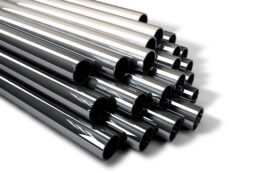
Today, welded pipes are among the most prevalent and widely used pipes in various industries, including construction, oil and gas transportation, water pipelines, and structural applications.
Did you know that the invention of welded pipes dates back to the 19th century? Major developments in metal technology and welding paved the way for the creation of steel pipes by rolling flat steel surfaces into cylindrical shapes and welding the edges together.
Let’s explore the different types of welded pipes, their characteristics, and applications. We will also compare them with seamless pipes, another popular type of industrial steel pipe.
Table of Contents
ERW Pipes (Electric Resistance Welded Pipes)
Manufacturing Process:
ERW pipes are made by rolling metal and welding the edges using high-frequency electric resistance. This process gives them their name.
Characteristics:
- Smooth finish
- Cost-effective
- Used in medium and low-pressure applications
Applications:
- Scaffolding
- Automotive industry
- Structural applications
- Water supply
Popular Types:
- MS ERW Pipes
- GI ERW Pipes
- SS ERW Pipes
HFIW Pipes (High-Frequency Induction Welded Pipes)
HFIW pipes are a type of ERW pipe, where high-frequency currents are used to heat and fuse the edges without any filler material. This results in a strong, clean, and uniform weld, making them ideal for structural applications.
LSAW Pipes (Longitudinal Submerged Arc Welded Pipes)
Manufacturing Process:
LSAW pipes are produced by bending and welding steel plates using the submerged arc welding (SAW) process along the seam. This method ensures high durability and strength.
Characteristics:
- High strength and durability
- Superior weld quality and precise dimensions
- Suitable for large-diameter production (16″–60″)
- Stronger than ERW and SSAW pipes due to full penetration welding
Applications:
- Offshore pipelines
- Long-distance oil and gas transmission
- Urban water pipelines
- Structural applications
Popular Types:
- MS LSAW Pipes
- Carbon Steel LSAW Pipes
SSAW Pipes (Spiral Submerged Arc Welded Pipes)
Manufacturing Process:
SSAW pipes are manufactured by spirally winding a steel plate into a cylindrical shape and welding the seam using the submerged arc welding process.
Characteristics:
- Flexible diameter and length – Ideal for large-diameter pipes (up to 100 inches)
- Cost-effective – More efficient production compared to LSAW pipes
- Strong & durable – The spiral weld offers excellent pressure resistance
Applications:
- Water pipelines – Used for water transportation in urban and industrial areas
- Oil & gas – Suitable for low to medium-pressure oil and gas pipelines
- Structural uses – Piling, bridges, piers, and offshore platforms
- Construction – Found in highways, stadiums, and civil engineering projects
Popular Types:
- MS SSAW Pipes
- Carbon Steel SSAW Pipes
UOE Welded Pipes
Manufacturing Process:
UOE pipes are produced using the U-ing, O-ing, and Expanding method, where the steel plate is formed into a U and then O shape before being expanded for dimensional accuracy.
Characteristics:
- High mechanical strength
- Excellent dimensional accuracy
Applications:
- Offshore pipelines
- Large-scale energy projects
Leading Manufacturers of Welded Pipes
Major Manufacturers of ERW Pipes:
- M/s. Jindal Industries Limited (Hisar)
- M/s. Jindal (India) Limited
- M/s. Maharashtra Seamless Limited
- M/s. Surya Roshini Limited
- M/s. Utkarsh Tubes & Pipes Limited
Major Manufacturers of Large-Diameter Pipes:
- M/s. Steel Authority of India Limited
- M/s. PSL Limited
- M/s. Lalit Pipes & Pipes Limited
- M/s. JCO Gas Pipe Limited
- M/s. Surya Roshini Limited
- M/s. Mukat Tank & Vessels (P) Limited
- M/s. Surindra Engg. Co. Ltd
- M/s. Bhushan Steel Limited
About Madras Steels
Madras Steels is India’s leading supplier of industrial steel pipes, offering a diverse range of welded pipes, including ERW, HFIW, LSAW, and SSAW pipes. With branches in Chennai, Mumbai, Bangalore, Kolkata, and Delhi, we ensure the highest-quality steel products for various industrial applications.
Conclusion
Welded pipes play a crucial role in infrastructure, construction, and energy industries. Understanding the different types – ERW, HFIW, LSAW, SSAW, and UOE – helps in selecting the right pipe for the required application.
FAQs – Different Types of Welded Pipes and Their Industrial Applications
1. What are welded steel pipes and how are they manufactured?
Welded steel pipes are manufactured by rolling flat steel plates or coils into a cylindrical shape and welding the edges together using processes like electric resistance welding or submerged arc welding.
2. What are ERW pipes and where are they used?
ERW (Electric Resistance Welded) pipes are made using high-frequency welding and are widely used in scaffolding, automotive, structural applications, and water pipelines due to their smooth finish and cost-effectiveness.
3. What is the difference between ERW and seamless pipes?
ERW pipes are welded and more cost-effective for medium and low-pressure applications, while seamless pipes have no joints, offering higher strength and suitability for high-pressure environments.
4. What are HFIW pipes and their advantages?
HFIW (High-Frequency Induction Welded) pipes are a type of ERW pipe with strong, uniform welds created without filler material, making them ideal for structural and industrial applications.
5. What are LSAW pipes and where are they commonly used?
LSAW (Longitudinal Submerged Arc Welded) pipes are high-strength pipes used in offshore pipelines, long-distance oil and gas transportation, and large-diameter infrastructure projects.
6. What are SSAW pipes and their industrial applications?
SSAW (Spiral Submerged Arc Welded) pipes are spiral-welded pipes used in water pipelines, oil & gas transmission, construction projects, and structural applications like bridges and piling.
7. What are UOE welded pipes and why are they important?
UOE pipes are manufactured using U-ing, O-ing, and expanding processes, offering high mechanical strength and dimensional accuracy for large-scale energy and offshore projects.
8. What industries use welded steel pipes the most?
Welded steel pipes are widely used in construction, oil and gas, water supply, infrastructure, automotive, and civil engineering industries.
9. What are the advantages of welded pipes over other types of pipes?
Welded pipes are cost-effective, available in large diameters, offer consistent dimensions, and are suitable for a wide range of structural and industrial applications.
10. Who are the leading manufacturers of welded pipes in India?
Leading manufacturers include Jindal Industries Limited, Jindal India Limited, Maharashtra Seamless Limited, Surya Roshni Limited, and Steel Authority of India Limited.